Yahoo Sports
What Brazil’s recent election results mean for the 2027 Women’s World Cup
Yahoo Sports
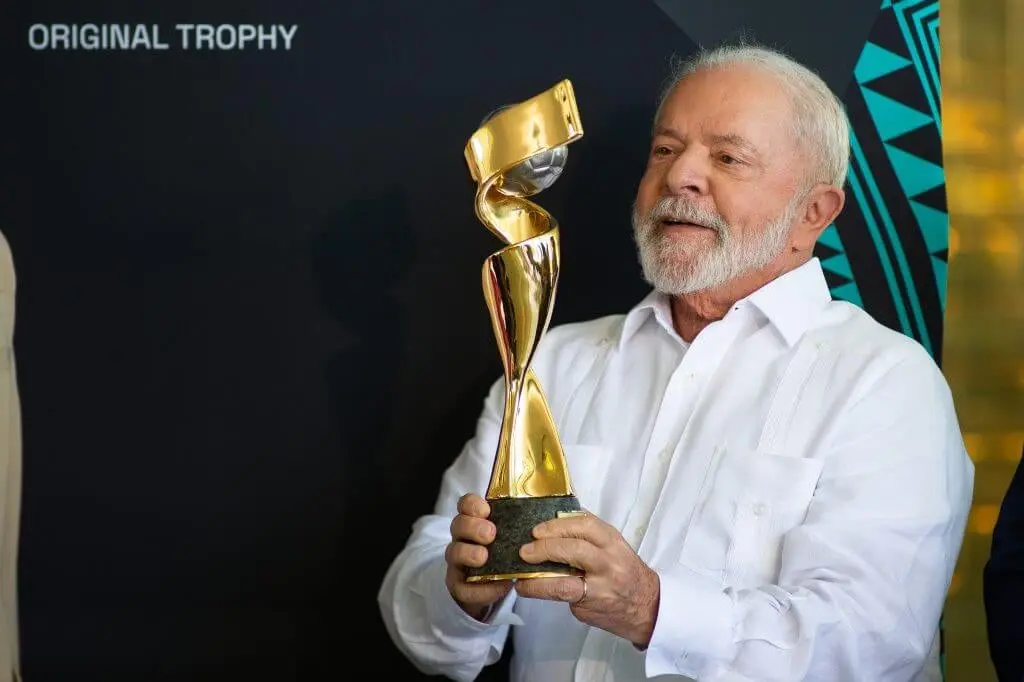
Shortly after the result of Brazil’s tightly-contested presidential election became official on Sunday, the country’s seven-time Women’s World Cup player Formiga shared a video on Instagram including a photo of her alongside its newly re-elected Luiz Inacio Lula da Silva.
“Today is a day to celebrate democracy, the strength of the Brazilian people, and the struggle of all those who believe in a Brazil that is fairer, more egalitarian, and full of opportunities for everyone,” the 48-year-old retired soccer player, who serves as Brazil’s director of football policies and women’s football at the Ministry of Sport, wrote in Portuguese.
The left-wing president, more commonly known as Lula, defeated the right-wing candidate Flavio Bolsonaro, son of the recently jailed former president Jair Bolsonaro, in Brazil’s presidential runoff.
Formiga was not the only Brazilian soccer player who celebrated his victory. Angel City FC and Brazil midfielder Ary Borges and Byanca Brasil , a forward for the Cruzeiro club in Belo Horizonte, Brazil’s sixth-largest city, showed their support as well.
For women’s soccer, it was an election with broader implications for the Women’s World Cup, which will be held across eight Brazilian cities next June and July.
While the full impact of Sunday’s result on the sport will unfold over the next seven months, a look at the history of women’s soccer in the South American country, as well as Lula and Bolsonaro’s respective policy histories, helps us understand some of what was at stake — and what might still be in limbo.
A post shared by Formiga🤟🏾 (@oficial_formiga)
For a nation that has produced some of the women’s game’s greatest players in history, including six-time world player of the year Marta and current NWSL stars Borges, Debinha, Angelina, Lorena and Bruninha, Brazil has a remarkably complicated relationship with women’s soccer.
In 1941, then president Getúlio Vargas, who had established a dictatorship in 1937, introduced a ban on women’s soccer that stayed in place for nearly four decades. This prohibited women from playing organized versions of the sport in Brazil until 1979. The decree was rooted in the belief that the sport was “incompatible with women’s physical nature and potentially harmful to motherhood.”
Before the ban, according to filmmaker Adriana Yañez’s 2024 documentary “ As Primeiras ” (The First Women), Brazil had approximately 15 recreational women’s teams, many made up of players from Rio de Janeiro and its suburbs. Even after the rule was lifted, official recognition of organized women’s soccer did not immediately translate into meaningful opportunities. It took nearly another decade for Brazil to establish a national team capable of competing internationally.
In 1988, the team participated in an invitational tournament in China, before making their FIFA Women’s World Cup debut in 1991 (though that competition, also in China, was officially and snappily titled the ‘1st FIFA World Championship for Women’s Football for the M&M’s Cup’).
Generations of female players continued to struggle for institutional support, funding and recognition in a country where the sport was practically a religion, but women were rarely invited to worship on equal terms.
For Brazil, the 2027 tournament is about more than staging the biggest event in women’s soccer. It is an opportunity to determine whether a country that once barred women from playing its most beloved game is finally prepared to invest in their future.
For Lula, it also presents a familiar opportunity.
Throughout his political career, he has sought to turn major sporting events into opportunities to showcase Brazil’s growing international influence, attract investment and strengthen national pride, even if it has been proven to be complicated at times.
At 81, Lula will now serve a fourth term as Brazil’s president. He previously governed from 2003 to 2010, a period in which Brazil secured the hosting rights to the 2014 men’s World Cup and the 2016 Summer Olympics, which were based in Rio. He was back in office when FIFA awarded Brazil this Women’s World Cup in May 2024, defeating a joint bid from Belgium, Germany and the Netherlands.
While he is also recognized for lifting Brazilians from extreme poverty and putting his country in the international spotlight, his presidencies, especially his second term from 2007, have hardly been without controversy.
In 2016, he became embroiled in Operation Car Wash, a corruption investigation that shook Brazil’s political and business establishment. He was convicted on corruption and money-laundering charges and imprisoned in 2018, a development that prevented him from contesting that year’s presidential election. However, after 580 days in jail, he was released in November 2019. In 2021, Brazil’s Supreme Federal Court annulled Lula’s convictions, ruling that the court that had tried his cases lacked jurisdiction.
The decisions restored Lula’s political rights and cleared the way for his remarkable comeback.
In 2022, he defeated Jair Bolsonaro to return to the presidency, completing one of the most extraordinary political reversals in modern Brazilian history. Bolsonaro is now serving a 27-year prison sentence for plotting a coup to overturn that election, while his son has fled the country amid money-laundering charges following Sunday’s defeat.
But it’s not just about electing Lula for many Brazilians. It’s about who they didn’t vote into power.
Bolsonaro senior’s presidency, from 2019 to 2022, was defined in part by his stance against women’s rights, LGBTQ+ issues and gender equality. In 2018, he shut down Brazil’s human-rights ministry, created a new ministry for women, family and human rights and appointed an evangelical pastor, Damares Alves, as its head. During his presidency, his political movement embraced a conservative vision of Brazilian society.
While more subtle than his father, Flavio had his share of policies and remarks that drew criticism. In May 2009, when he was serving as a state deputy in the Legislative Assembly of Rio de Janeiro, he was the only lawmaker to vote against a bill extending maternity leave for female public servants in that state from four to six months, claiming it would make it harder for women to be hired by employers.
In June this year, the government, with Lula at the helm, introduced “legislation 15.421 of 2026” ( Lei 15.421, de 2026 ), known as the World Cup Law, establishing women’s soccer as a national sports policy priority.
This legislation seeks to secure commitments from ministries, the Brazilian Football Federation (CBF) and professional clubs to invest in the women’s game and to build a lasting legacy beyond the upcoming month-long tournament. The law also recognized the contributions of the women who represented Brazil, approving payments of R$500,000 ($93,000; £69,000) to eligible members of Brazil’s pioneering 1988 and 1991 national teams, acknowledging the financial and professional opportunities denied an entire generation.
“Brazil is a complex country, but we have a strong democracy,” Alicia Peres, a documentary filmmaker and LGBTQ+ activist told The Athletic . “No president could dictate who plays in the World Cup or visits our country, but symbolically, it would make a significant difference.”
While his history of bringing successful international tournaments to the country suggests Lula understands the political and economic value of hosting major sporting events, how his nation will handle a competition with such massive implications for women’s soccer is yet to be seen.
Hosting a World Cup requires far more than building stadiums and selling match tickets. It should have a long-lasting legacy for the country’s people.
The 2014 men’s World Cup and 2016 Olympics were accompanied by enormous public spending, political controversy and questions about whether the infrastructure investments ultimately benefited Brazilians.
With his latest re-election, Lula has an opportunity to do a better job this time.
He has less than a year to demonstrate that Brazil can deliver not just another spectacular soccer tournament, but one that leaves the women’s game there stronger than it found it.
This article originally appeared in The Athletic .
Women's Soccer, FIFA Women's World Cup
2026 The Athletic Media Company
Mannschaftskontext
Form, nächstes Spiel und Tabellenplatz der in diesem Artikel genannten Mannschaften.
