Yahoo Sports
Inside the NWSL venue saga: Spirit land Audi Field, Gotham move to 5K-seat Icahn Stadium
Yahoo Sports
The messages started picking up in the 80th minute of the Washington Spirit’s quarterfinal game against the Portland Thorns. The Spirit, playing in front of another sold-out Audi Field crowd, were leading 4-1. A third semifinal berth in three years looked all but certain, and, thanks to the No. 7 Utah Royals upsetting the No. 2 San Diego Wave on Friday, that game would be at home — or at least near home.
The phones of several executives from the Spirit, D.C. United and the National Women’s Soccer League continued to ping as the game neared the 90th minute. They were all working to pull off a scheduling miracle.
Going into Sunday’s quarterfinal finale, the most likely venue for the Spirit’s to-be-confirmed semifinal was not Audi Field, but Northwest Stadium, home of the Washington Commanders, roughly 10 miles outside the city in Landover, Md. Due to a complicated matrix of priorities, a Spirit win would have meant Washington conceded the right to host a semifinal at Audi Field so that No. 1 Gotham FC could maintain home-market advantage, the best kickoff time and schedule preference.
The equation was made more complicated by the fact that neither Gotham nor the Spirit owns their stadium, and the venues had already been booked for other events on Saturday.
The last wrench in the plans came earlier Sunday when Gotham beat the Seattle Reign 1-0, overcoming not just their opponent but a playing surface that players and coaches called “atrocious” and said should not have been played on. Gotham was fined $10,000 for the conditions of the field a week prior. That same field was set to host the semifinal a week later, with no planned repairs outside of normal maintenance and additional wear and tear expected.
Despite boasting teams valued upwards of $200 million, even the best clubs in the NWSL don’t always control their own destiny — something the league looks to improve as it brings in more expansion teams.
Messages turned into phone calls Sunday night as the results were finalized. The Spirit had secured their most favorable outcome, while 221 miles north on Interstate 95, Gotham FC continued to troubleshoot their options. The saga ended Monday afternoon with the Spirit getting to play at Audi Field while Gotham FC moved to Randall’s Island in New York City, hosting their first semifinal at the 5,000-seat Icahn Stadium.
Despite not facing each other, Gotham and the Spirit’s journeys to the semifinals were tightly intertwined, with several phone calls, years of relationship building, negotiations, confirmed locations and last-minute changes leading to the 2026 NWSL semifinal locations.
This is the entire ordeal as it happened.
12:30 p.m. ET — Sports Illustrated Stadium, Harrison, N.J.
Gotham FC lifted their first NWSL Shield, awarded to the team with the best regular-season record, a week prior on Decision Day. They entered Sunday’s match as the top seed for the first time in club history. It was a new position for Gotham, who previously won two NWSL Championships after entering the postseason as the lowest-ranked team.
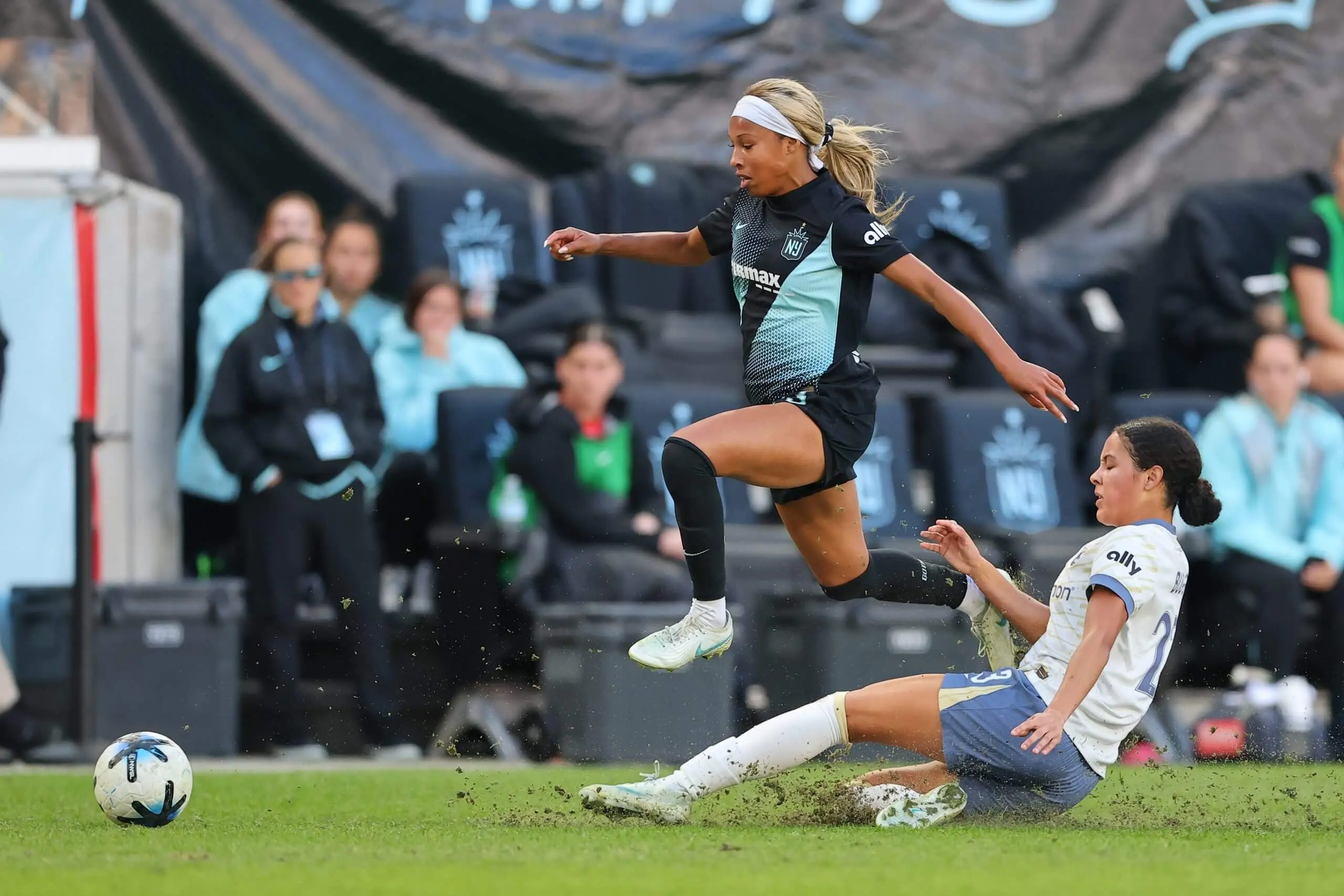
Four minutes into their match against the Reign, Jaedyn Shaw’s corner kick deflected off Seattle defender Jordyn Bugg for the lone goal of the game. Gotham secured their semifinal spot without registering a shot on target. Their biggest opponent of the day wasn’t a team or person, but the pitch.
The field had large patches of worn grass and visible holes scattered throughout, including near the corner flags. Gotham defender Jaelin Howell described the pitch as “sandy,” and Shaw said after the game she had trouble taking corner kicks because her plant foot would slip. The corner where she delivered the ball that led to the winning goal was especially problematic. At one point, a referee could be seen filling a hole by the corner flag by pushing turf into it before another corner was taken.
The poor conditions already cost Gotham $10,000 in fines following their Nov. 1 home game against Utah, which took place two days after a USA Rugby Fall Series doubleheader. Under the league regulations, fines for field conditions are imposed on the home team, regardless of whether the club controls the venue or its event schedule. Gotham leases Sports Illustrated Stadium from the owners of Major League Soccer’s New York Red Bulls but were held financially responsible for the fine.
Gotham had attempted to address the field conditions when they realized how bad it was, even before the Utah game. Their efforts included offering to pay to reseed the grass, but the problem persisted, according to sources familiar with the matter who spoke on condition of anonymity so they could speak candidly and protect their relationships.
On Friday, a field consultant inspected and tested the pitch and determined that it met FIFA standards. The field’s condition after Saturday evening’s MLS game between Red Bulls and Atlanta United was deemed playable as per representatives from the venue, the league’s operations team and the Professional Referee Organization (PRO) on Sunday before the quarterfinal, according to a source familiar with the matter.
Still, Gotham FC exhausted every path in an attempt to improve the playing surface ahead of Sunday’s game, a club spokesperson told The Athletic. The NWSL Players Association raised the question of player safety after the game. Head coach Juan Carlos Amorós shared a similar sentiment in his postmatch comments.
“I feel the obligation to almost apologize for the state of the pitch,” Amorós said. “At this level, in this kind of game, as a league, we should be having a better surface.”
Amorós said he had to adjust his game plan to account for the conditions in an attempt to mitigate the risk of injury. Various players and both NWSL head coaches referenced the field quality after the game, saying it impacted play. Seattle forward Jess Fishlock, who played her final game Sunday, called it “atrocious.” Gotham players were visibly frustrated when exiting the pitch into the player tunnel.
“We understand how frustrating the move is for Gotham and their fans. We had hoped to see Gotham continue their championship run at Sports Illustrated Stadium, too,” a spokesperson for Red Bulls said. “We invest in the pitch year-round with a dedicated grounds team and specialist field partners, and it was cleared for every match played there this season. Those inspections continue for all remaining events this year.”
Reign head coach Laura Harvey said players “should never have been made to play on a field like that in a playoff game,” adding it was “the worst field I’ve played on in this league.
“It definitely affected the game. And I’m not saying it was just us. I’m sure it affected them. I’ve got the head coach apologizing to me before kickoff at how bad the field is.”
The quarterfinal ended with Gotham securing their first semifinal game at home, and confusion over where their next game would be growing.
3 p.m. ET — Audi Field, Washington, D.C.
The Spirit played one of the more exciting attacking games of the weekend, defeating Portland with multiple goal contributions from their star forward Trinity Rodman.
A crowd of 19,215 people reached a crescendo after every goal. Despite being only tenants at Audi Field, a venue owned by D.C. United, the Spirit have the third-highest average attendance in the NWSL (15,152). Their sold-out crowds are the reason the stadium has the nickname “Rowdy Audi.”
The push for the semifinals to be played at Audi Field came directly from Spirit players, sources familiar with the situation told The Athletic . Players had a “strong, strong preference” to play there, a source said, with a sense that they deserved to play in front of their fans in the place where they had created a strong home-field advantage.
With a three-goal lead over the Thorns going into halftime, Washington’s front office got the ball rolling. Haley Carter, the Spirit’s president of soccer operations, stressed to CEO Kim Stone how important it was for the players to play at home. Owner Michele Kang was also looped in, and the green light was given to try to make the impossible happen.
Though playing at Audi Field on Sunday was an option from a venue standpoint, the Spirit were boxed out of hosting then due to Gotham’s priority as the No. 1 seed. Saturday at Audi Field was originally off the table due to the 46th Secretaries’ Cup football game between Division III U.S. Coast Guard Academy and the U.S. Merchant Marine Academy set to take place at 1 p.m. that day, which had been announced in August.
The NWSL developed multiple scheduling scenarios ahead of the quarterfinals, prioritizing keeping teams in their home markets and preserving reasonable kickoff times over guaranteeing that higher-seeded clubs play at their regular stadiums, according to league documents obtained by The Athletic .
The league’s scheduling framework followed four priorities, ranked in order of importance: preserving home-market advantage, securing appropriate kickoff times, protecting the higher seed’s scheduling preference and, only as a last resort, reversing the designated home team, according to the document reviewed by The Athletic . The document showed that the NWSL evaluated the semifinal schedule as a whole rather than treating each matchup as an independent scheduling problem.
A decision that appears unfavorable to one club might be necessary to avoid a more significant disadvantage for another, especially around broadcasting windows set in primetime television for the weekend.
For Spirit players, unfavorable wasn’t going to fly.
On Sunday, the team’s leadership began calling those in charge at D.C. United, including president of business operations Danita Johnson, who spearheaded the efforts on the MLS side, to try and navigate a solution. One source called it a “Hail Mary” when Spirit proposed buying out the college football game. That’s where one of the teams’ shared sponsors, Lafayette Credit Union, offered to subsidize that cost, which was estimated to be in the “low six figures.” This was in addition to their existing partnership.
As Spirit head coach Adrian Gonzalez and players addressed the media under the stadium, behind the scenes all sides came to a resolution for the Spirit to stay at Audi.
The caveat remains that the college football game on Saturday is now a doubleheader with the NWSL semifinal match between Spirit and Utah. The Spirit are expected to exit the playing area “in a reasonable amount of time” after the final whistle so organizers can prepare for the second game. The Spirit will kick off at noon ET.
The Spirit were eager to get the news out, originally wanting to have it confirmed by full time so they could start selling tickets. Instead, they were set in a waiting pattern while Gotham sorted out their venue issues. When the league announced the semifinal matchups around 9 p.m. ET on Sunday, Audi Field was confirmed but Gotham was listed without further venue details.
Monday — Various locations, the Mid-Atlantic Region
By midday Monday, Sports Illustrated Stadium was still on the table to host a semifinal under the condition that the field undergo immediate repairs.
While executives determined whether that would be feasible, the option to move the match to Icahn Stadium came back into play. Players in particular preferred the better pitch. One other option, the last-case scenario, was also floated. The Kansas City Current offered to host Gotham at their purpose-built stadium, according to sources. However, the loss of home-field advantage for the No. 1 seed eliminated the possibility.
The league, Gotham and the New York Red Bulls spent much of Monday determining their options. Laying down new grass was ruled out because of time constraints. The best option was to restore the field using a hybrid stitching model, which involves repairing damaged portions of the pitch with artificial turf.
Despite the shorter amount of time needed for this solution and NWSL’s willingness to move forward with covering the repairs, there was no guarantee it would be ready in time for the Red Bulls’ game on Saturday, according to people familiar with the discussions. The solution was abandoned.
Upon exhausting all possible options, Gotham and the league agreed to move the game to Icahn Stadium.
“For the first time in club history, our players have earned the right to host a semifinal match at home, and our fans have earned the opportunity to be part of that historic moment,” Gotham FC governor Carolyn Tisch Blodgett said in a statement. “Unfortunately, given the field conditions, we have made the extremely difficult decision to relocate our semifinal game to Icahn Stadium.
“We are deeply disappointed that so many of our fans will now be unable to experience this moment alongside our team. Our players deserve a playing surface that meets the standards of a professional semifinal, and our fans deserve the opportunity to support them. We have worked tirelessly to deliver on both and are disappointed that we cannot.”
The Red Bulls will still play their game against Club América on Saturday, saying in a statement, “We wish Gotham FC the best of luck in their semifinal at Icahn Stadium. We look forward to our match at Sports Illustrated Stadium.”
Gotham previously played at Icahn Stadium when Sports Illustrated Stadium was unavailable during the men’s World Cup on July 18.
The team consulted Amorós and the players and together determined that the most important thing was prioritizing the best playing surface for the “athletes to perform at their best,” Yael Averbuch West, the president of soccer operations for Gotham FC, said in a statement.
Gotham announced Monday that semifinal tickets would be released in three phases, prioritizing season-ticket holders and loyal fans. Fans who already purchased a ticket will have their ticket honored and also receive a partial refund for the difference in price.
The smaller venue means that many of Gotham’s usual fans may not be at the semifinal because of limited seating at Icahn. Gotham’s supporters group, Cloud 9, said in a statement, “Although we are deeply disappointed to not be playing such an important match at our home field, our priority is protecting the players and making sure they have the conditions they need to succeed.”
The NWSL’s reliance on stadiums controlled by other organizations in some of the league’s biggest markets has exposed a fundamental vulnerability.
Gotham has already taken steps to address its long-term stadium situation.
Last July, the club announced that beginning in 2028, it will relocate to New York City FC’s new $780 million, 25,000-capacity stadium, Etihad Park . Gotham is expected to have a more balanced relationship with their stadium partner, with greater influence over scheduling. But that move is still over a year away. Until then, Gotham remains at the mercy of scheduling decisions outside its control.
The Spirit continue to evaluate options for their future, including staying at Audi Field. As D.C. United pushes for renovations on their stadium, the Spirit continue to seek options that bring them favorable economic opportunities.
The break-in-case-of-emergency scenario of having Gotham’s semifinal at Kansas City’s CPKC Stadium shows the privilege the Current have as one of the only teams with a purpose-built stadium.
As interest in owning an NWSL franchise continues to rise, the league is placing greater emphasis on infrastructure and the degree of influence the clubs can exercise over their home venues. For clubs sharing stadiums with men’s professional teams, that means having a meaningful role in scheduling decisions rather than simply accepting whichever dates remain available.
Expansion clubs in Atlanta and Columbus , who start play in 2028, have ownership structures connected to established men’s professional soccer organizations, potentially giving them greater influence over stadium operations and scheduling. Other recent expansion markets, including Denver and Boston, are building and/or renovating venues where they will control their scheduling.
The league’s playoff scheduling difficulty also coincides with the league’s review of the long-term structure of its competition calendar.
MLS’ shift to a fall-to-spring season could bring extra complications for clubs sharing stadiums with MLS teams and other tenants, particularly as leagues navigate overlapping schedules, weather conditions and competing venue commitments.
Building dedicated stadiums offers one answer, but it cannot be the only one. In crowded sports markets like New York and Washington, where land and construction costs are much higher and existing venues can serve multiple teams, building a new stadium is neither realistic nor necessarily the best use of resources.
For a league that spent years proving its value within major American sports leagues, the next challenge is ensuring it has influential infrastructure.
— Emily Olsen and Tom Bogert contributed to this report.
This article originally appeared in The Athletic .
Gotham FC, Washington Spirit, NWSL, Sports Business, Women's Soccer
2026 The Athletic Media Company
Contexto del equipo
Forma, próximo encuentro y posición en la liga de los equipos de esta historia.