Yahoo Sports
What makes a reliever of the year?
Yahoo Sports
LOS ANGELES — The Baseball Writers Association of America added a new award this season, honoring the top relief pitcher in each league each year. The inaugural winner of the National League Reliever of the Year is Mason Miller in a landslide.
The San Diego Padres closer received all 30 first-place votes. His stats tell the story, as Miller put up a 1.67 ERA, best among all National League pitchers with 50 innings. Miller was also tops in xERA (1.70), FIP (1.17), xFIP (1.54), strikeout rate (an eye-popping 47.4 percent), strikeout-minus-walk rate (37.9 percent), and saves (38, in 41 attempts).
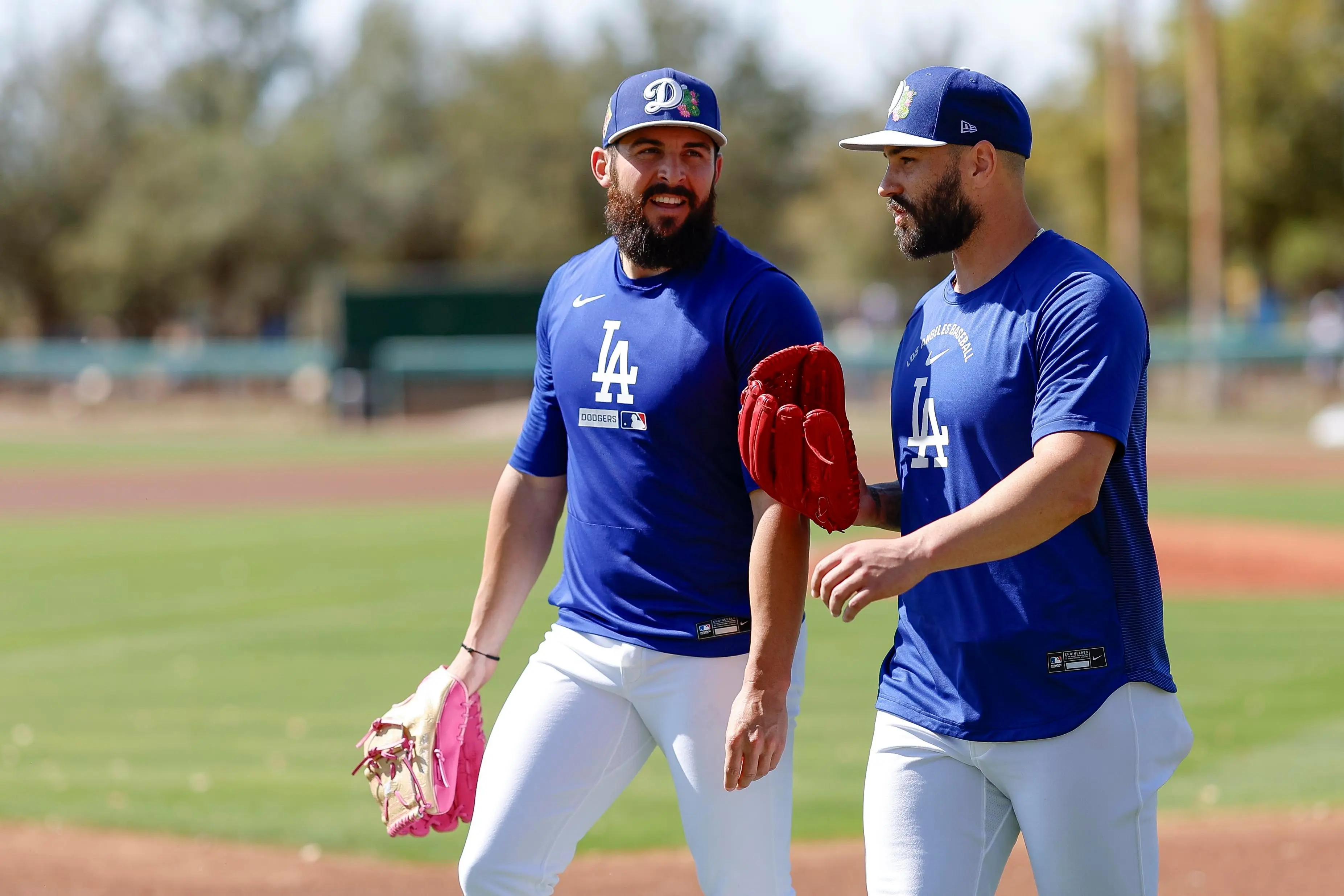
I had a vote in this award this year, and I voted Miller in the top spot. Before casting my ballot, I asked a few Dodgers relievers how they might define relief pitcher of the year, and in the course of our conversations, Miller also gained their respect, too.
“It’s got to be Mason Miller,” said left-hander Alex Veisa. “He has been unbelievable to watch. His stuff is — you know, when he was in Oakland, right, it’s like how could someone get any better? And he’s still getting better.”
“It will probably be limited to a closer role, and in the National League for closers, how can you not say Mason Miller?” asked southpaw Jack Dreyer.
I was not only certain pretty early on about Miller in the top spot, but also Johan Duran of the Philadelphia Phillies seemed like the clear choice for my No. 2 on the ballot. Duran saved 33 games in 35 tries, all while finishing second to Miller among NL relievers in ERA (1.82), xERA (2.04), FIP (1.41), xFIP (1.74), and strikeout-minus-walk rate (31.4 percent).
“Someone that contributes to a winning baseball team and the biggest moments, he gets outs there frequently,” said right-hander Evan Phillips. “It’s interesting to point out a couple guys down there in San Diego that have been used a ton this year — Mason Miller and Adrián Morejón. Obviously Mason more in the traditional closer’s role, but what Morejón’s been doing, the workload he’s had this year, and how much they relied on him, that’s notable to me.”
Adrián Morejón, a former starting pitcher, was incredibly effective out of the bullpen in San Diego, posting a 2.83 ERA in 76 games for the Padres, with a 2.33 xERA, 2.37 FIP, and 2.64 xFIP in 86 innings.
We all saw what left-hander Aaron Ashby did for the Milwaukee Brewers in October, putting up one of the great postseason runs ever by a reliever, throwing 18 scoreless innings with 20 strikeouts and three walks. Eight of his nine appearances lasted at least five outs, including a three-inning save to close out the Dodgers in Game 4 of the National League Championship Series .
“That award should probably go to like some version of closer of the year, just because of leverage spots,” Dreyer said. “I think there’s also value to appearances and that kind of the thing.”
Morejón was second in the NL with 76 appearances, and Ashby was third with 75. Ashby pitched 89 1/3 innings, while Morejón pitched 86. Here’s how these two busy relievers compared:
Morejón: 2.83 ERA, 2.33 xERA, 2.37 FIP, 30.4% K rate, 8% BB rate, 1.1% HR rate
Ashby: 3.12 ERA, 2.98 xERA, 3.11 FIP, 30.3% K rate, 10.7% BB rate, 2.1% HR rate
Morejón had the edge in ERA, xERA, and FIP, with fewer walks and fewer home runs allowed. That earned Morejón my third-place vote.
“Ashby — I don’t understand that. It’s 98 to 100 from up here and sinking and curving,” Dodgers first baseman Freddie Freeman said before Game 4 of the NLCS. “They’ve just got a lot of weapons.”
Those other weapons in the Brewers bullpen included closer Trevor Megill and right-hander Abner Uribe.
“It’ll be interesting to see how it’ll get voted on. Whether it’s best closer award or best overall reliever, pitching in leverage,” Phillips said. “You’ve got guys from Milwaukee pitching multiple up-downs, I gues you could say four or five outs at a time — Ashby, Uribe. With Trevor Megill the more traditional closer, they have guys just throwing a ton of inning and getting a lot of high-quality outs.”
Here are the three main Brewers relievers:
Megill: 61 2/3 IP, 30 saves, 2.63 ERA, 2.63 xERA, 1.85 FIP, 28.5% K rate, 6.2% BB rate, 0.4% HR rate
Ashby: 89 1/3 IP, 4 saves, 3.12 ERA, 2.98 xERA, 3.11 FIP, 30.3% K rate, 10.7% BB rate, 2.1% HR rate
Uribe: 59 1/3 IP, 6 saves, 1.97 ERA, 2.80 xERA, 2.68 FIP, 26.5% K rate, 8.2% BB rate, 1.3% HR rate
“You’re grouping two sets of pitchers together in this category. There’s a closer who has a defined role, who’s only pitching in the ninth when the game’s on the line, okay, great. Then there’s relievers who pitch the sixth, seventh, and eighth inning, depending on the leverage of the game,” Vesia said. “Those are two completely different situations, and both have their challenges. Both have a debate on which is harder, what’s easier.”
I threw in Tanner Scott here with the same stats as the Brewers trio above, and he held up quite well:
Scott: 63 2/3 IP, 25 saves, 2.69 ERA, 3.04 xERA, 2.09 FIP, 32.7% K rate, 6% BB rate, 1.6% HR rate
After Miller and Duran locked into my top two spots, I really wanted to make room down ballot for someone with a three-inning save or even multiple. Had we voted after the NLCS, Ashby obviously would have rocketed up my list, but there wasn’t any other reliever that I could really justify voting for on the strength of a relative novelty.
I gave Morejón the edge over Ashby for my third-place vote, and I thought Ashby’s 30 more innings vaulted him over his teammate Uribe. But I went with Megill fourth and Scott fifth over Ashby, for a few reasons.
Megill was very steady. FanGraphs measures shutdowns and meltdowns, both based on fluctuations in win probability added. Megill had 34 shutdowns against only six meltdowns, and was third among NL relievers with a 1.85 FIP, trailing only Miller and Duran.
Scott pitched 19 times on zero days rest, the second-most appearances among NL pitchers .
“As long as you stick to your routine, do everything that you need to do to get ready to throw your prep and your post — shoulder care and arm care is huge. When you have that rhythm of that system scheduling down, just don’t do anything else,” Scott said, explaining his mindset. “It goes in the back of your head, you feel ready for every single day, even if you went two days or three days in a row.”
“Availability, just being able to go out there and get those reps and be that guy your team can rely on, it means a ton,” Phillips added.
In addition, here is the average leverage index for each of these pitchers when entering a game, as calculated by FanGraphs (1.0 is average, and anything above is above-average leverage, i.e. tougher situations):
Mason Miller 1.86 (2nd)
Tanner Scott 1.82 (3rd)
Adrián Morejón 1.80 (4th)
Jhoan Duran 1.71 (5th)
Trevor Megill 1.70 (6th)
Abner Uribe 1.66 (9th)
Aaron Ashby 1.37 (24th)
My ballot was Miller 1st, Duran 2nd, Morejón 3rd, Megill 4th, Scott 5th.
Scott finished in eighth place for the award, and appeared on seven ballots. Seven points were awarded for each first-place vote, then four points for a second-place vote, three points for third place, two points for fourth place, and one point for fifth place.
Kontekst timova
Forma, sledeća utakmica i pozicija na tabeli za timove iz ove priče.